Piccolo · treble clef
Piccolo Fingering Chart
Every note on the piccolo, from low D to high C. The first two octaves match the flute; several third-octave notes use piccolo fingerings.
Written pitch. The piccolo sounds an octave higher than written.
First octave
Lowest note on the piccolo: cover every hole and use gentle air. The right pinky stays up.
Use the right ring finger, not the middle finger.
Left pinky presses the G♯ key.
Thumb B♭ sounds clearer and more in tune on piccolo than one-and-one.
The left thumb comes off.
Only the right pinky stays down; this note can sound weak, so keep the air focused.
Second octave
Like low D, but lift the left index finger.
Like low D♯, but lift the left index finger.
Uses the same fingering as low E; blow faster air.
Uses the same fingering as low F; blow faster air.
Uses the same fingering as low F♯; blow faster air.
Uses the same fingering as low G; blow faster air.
Uses the same fingering as low G♯; blow faster air.
Uses the same fingering as low A; blow faster air.
Same as the lower B♭; blow faster air. Thumb B♭ sounds clearer and more in tune on piccolo than one-and-one.
Uses the same fingering as the lower B; blow faster air.
Same fingering as the C in the staff (C5); blow faster air.
Pitch on this note varies from piccolo to piccolo, so check it with a tuner. If it is sharp, the right-hand-down alternate brings it down.
Third octave
Like the D in the staff (D5), but lift the right index, middle and ring fingers and put the pinky down.
Every finger down plus the G♯ key; not the same as the lower D♯ fingerings.
Left ring finger is lifted, unlike the lower E.
Left middle finger is lifted.
Piccolo F♯ uses the right middle and ring fingers with the pinky up; it responds better than the flute fingering.
Same as the lower G but with the thumb off.
Add the right middle and ring fingers to the flute fingering for better response and pitch.
Uses the first trill key; the right pinky lifts off the D♯ key.
Uses the second trill key; the right pinky lifts off the D♯ key.
Thumb off and right pinky up. Some players rest the pinky on the end of the piccolo without covering the opening.
Printable chart
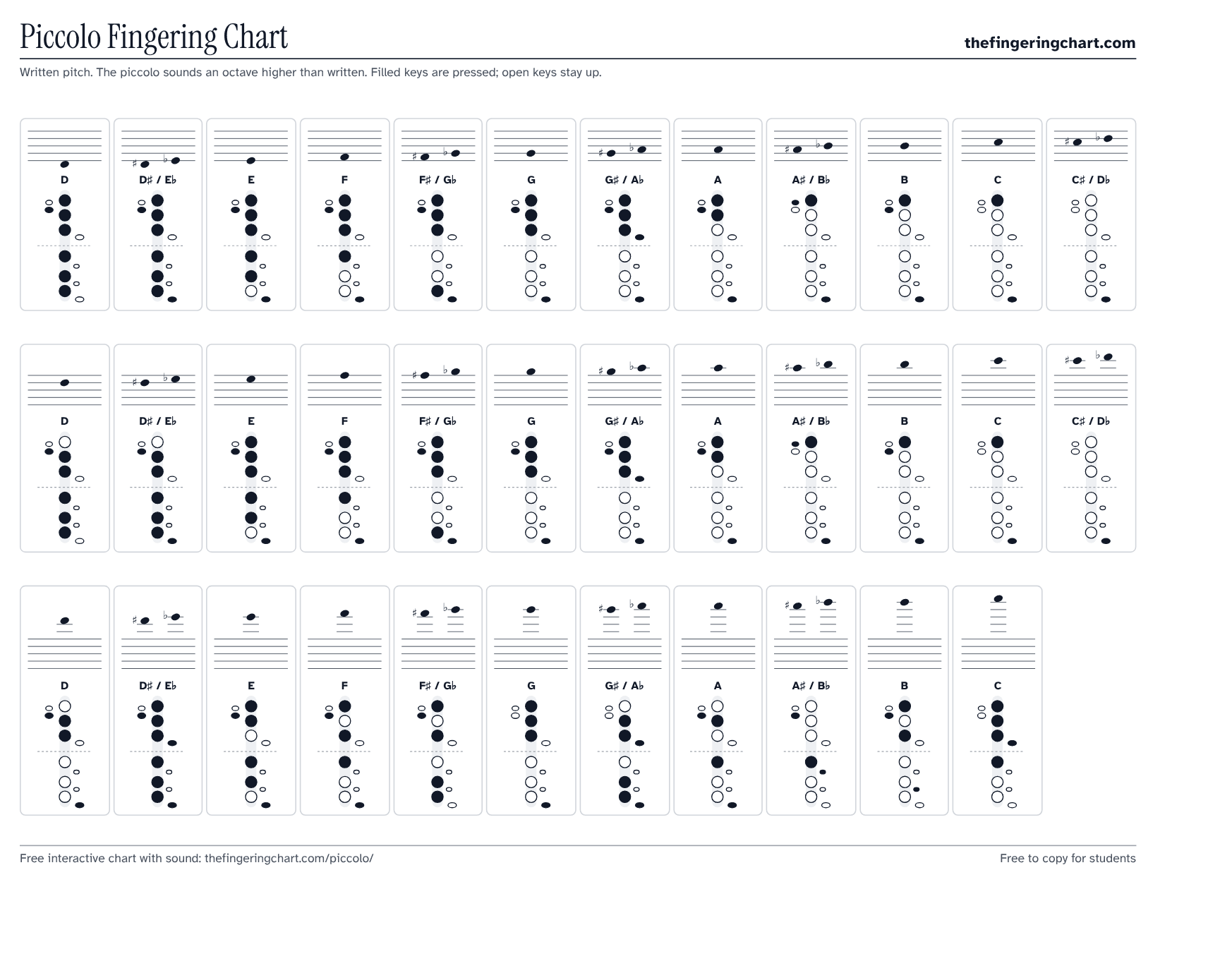
How to read this chart
Filled keys are pressed. Open ones stay up.
The two thumb keys are drawn to the left of the first finger. The dashed line separates the left hand (top) from the right hand (bottom).
The piccolo has no foot joint, so its lowest note is D.
Which notes come first
Flute players moving to piccolo can keep their low and middle fingerings. Learn the piccolo versions of the high F♯ and G♯ first.
Next: Piccolo scales